Thursday, May 27, 2021

When the Levee Breaks

 Today those persons in our Holston Conference preparing to be recognized as Associate Members, those being commissioned as Provisional Elders (this is me 😁), and those being ordained as Elders in Full-Connection (prayers this is me in 3 more years), met today in Alcoa for "A Day With the Bishop". It was a time of learning, recognition, celebration, and getting to know others in our "class" as we embarq on the next phase in our ministerial journey. 

And since I had a 2-hour drive both ways, I got to listen to a couple of my favorite podcasts, and of course listen to some of my favorite music. And today was a Led Zeppelin feelin' kinda day. So I listened to a buch a Zep on the way down. 

One song stuck out to me today, "When the Levee Breaks". I've listened to it thousands of times in my life, it's really a great tune. One of the bluesy tunes off of Zeppelin IV where Robert Plant kills it on the harmonica. The chorus says, 

If it keeps on rainin', levee's goin' to break
When the levee breaks, I'll have no place to stay


The image during the song is that it's been raining a lot, and the levee has the pressure from all the storms, and if the levee breaks it will flood the village and the singer will have no place to live. The flooding would cause destruction and devestation and wipe out what is valuable. 

Today as I was listening to this on my way to Alcoa, I was thinking about the levees, or dams, in our lives. Not literal Boone Lake Dams, but the spiritual ones. Although that Boone Lake Dam might make a good sermon illustration too, the leaks down below the service at the bottom that aren't realized until it's almost too late--firm foundations are important in life and in dams. 

But I think that we store up things, dam up things, keep things held in place by levees, and this can do us harm over time. 
Maybe the dam needs to open, maybe the damn levee needs to break. 

Think for a minute about the things that we store up behind our levees; things like anxiety, stress, depression, low self esteem, poor self image, fear, uncertainy for the future, and regrets from the past, anger, bitterness. The list could go on and on. 

I think that sometimes we store these things behind the levee. After all, we know they shouldn't be there in our good Christian lives, so if it shouldn't be there let's just pretend it's not there, right? And the result is more and more crap being stored up behind that levee, until one day...it breaks. 

I think that is a good thing. 

Surrender is at the heart of our faith. It's not about having an industrial strength re-inforced levee to hold it all in. Maybe it's time to let it out,

My wife is a much better letter-outer than I am, but I am learning from her, and learning from Jesus more and more each day. 

The only way to be filled with the rich goodness of this life is to let go of some of the things that don't need to be there, that don't need to be in us. And sometimes that might seem easier said than done. But often times it's because we have a white-knuckle grip on these things, saying we want to let go but holding on. And when we do let go sometimes it is more of a sssllloooowwww slipping from our clinched fingers rather than a wide open full release. 

One daily practice that I believe can help with this is engaging in what is known as release prayers.

If you're holding onto some of those things I listed above, or you have your own specialized and personalized list of levee-kept issues. How about we try this together? 

1. Get comfortable. Not curled up with my favorite blanket ready for a nap comfy. But rather just find some stillness. Turn off the distractions (yes, that would be the TV....and yes, you need to lay your phone down). 
2. How do you feel? Where are you holding tension in your body? Why is it there? Think more about how you feel spiritually and emotionally rather than physically, although that physical condition might be causing how you are feeling emotionally. You can get sick and tired of feeling physically sick and tired which will make you emotionally and spiritually sick and tired. 
3. Name you feeling. 
4. Visualize God with you. Not the theoretical head knowledge that you've gotten from decades at church that God is with you. I mean really personalize to visualize God with you. Feel His presence. Talk to Him. Acknoweldge that how you feel and God with you are both very present realities. 
5. Now, release how you are feeling to the Lord. Picture Jesus taking your anxiety, and removing it. See the Holy Spirit covering your fear with His comforting presence. Even if your feelings are all positive today, visualize releasing the joy in your heart and peace in your mind as a thanksgiving offering to God. 
Release. 
6. Pray. Verbalize it to acknowledge God taking what you have given Him, you are releasing what is not your responsibility to carry in the first place. Besides, we weren't created to be strong enough to carry it all anyway, or to keep it leveed up. And now, give thanks, breathe, and move on. 

I don't want to over simplify this, and I am aware that some things we are holding onto are harder to release  than by just following the simple steps above. And I agree. 

That's why the levee needs to break! 
May the Lord break your levee today to allow a fresh release of what you ahve been holding in, and a fresh release of His Holy Spirit to be poured out upon and fill you in a might new way. 

If you want to check out the song referenced in today's blog, here ya go: When the Levee Breaks

Monday, May 24, 2021

Pentecost- A miracle of hearing

 Yesterday was Pentecost Sunday. It is a vibrant and colorful day in the life in of the Church, and in many local congregations. It is also just a fun Sunday to preach on the events recorded in Acts 2, which is what I do every year. The thing about preaching the exact same text for 13 years, however, is the fear that at some point I will just start staying the exact same thing. 

Thankfully, that hasn't happened (very much) yet. As I was reading Acts 2:1-21 this year there were a few things that really stuck out to me. 

First, was the image of the disciples "all togehter in one place" (2:1). I had never really thought much about that until last year, when we were not all together in one place for Pentecost worship. We were isolated, quarantined, even perhaps fearful. Many people felt alone and disconnected. Thankfully this year we were (mostly) together in one place again. And that was a powerful feeling for me, and I hope for you as well if you were able to be gathered together with others for worship. I also pray that we do not take these times of togetherness for granted. God is always moving in and among us, but I truly believe that there are some pretty amazing things that we realize and recognize that God is doing when we are "all together in one place". 

Another point that really hit me this year was that after all of these people who were in Jerusalem heard the commotion and went to check it out, they said, "we hear them declaring the wonders of God in our own languages (2:11). This is as much of a miracle of Pentecost as the arrival of the Spirit in an exciting and disruptive new way. 

We hear them!

Over the past few years, I have been more keenly aware of how little we hear other people. Especially people that are different. And there were so many different people in Jerusalem during this story in Acts 2. They are all together in the city because it's Pentecost, a Jewish festival to celebrate the giving of the law to Moses, celebrated 50 days after Passover. Different people, from different lands (just check out the listing in verses 9-11!), different languages, different dress. But one thing in common. 

(Side note: Apparently I often, OK, well, weekly, make some sort of song reference in my sermons. When I was preaching this Sunday I was talking about the different people but with one thing in common. After the service a church member told me I missed a great musical reference there, even with all these different people they had "one thing in common, the fire down below". So, here's a little Bob Seger to boost your day: The Fire Down Below.  Thanks Chuck!)

The one thing in common was that they were all followers of the One, True God. And that one thing in common was more than any difference. I think the same is true today, which is why Peter emphatically states, "And everyone who calls on the name of the Lord will be saved." (2:21)

I wonder, what wonders of God that we could proclaim today so that others could say, "Yeah, I hear you!"?

 How could we speak in such a way that others could understand?

I don't have all the answers to that, but I believe that is begins with declaring the wonders of God we have seen in our own lives, and doing that in love for others and praise for the Lord. I believe it begins with being flled with the Spirit ourselves, and as the old hymn says, seeing "sweet expressions on each face. And I know you feel the presence of the Lord." And I believe that it begins, as all things should, in love. I believe that this is not forcing others to understand what we are saying in our language, but speaking in such a way that others are able to hear it in thier own language, right where they are. 

May we speak today of the wonders of God in a way that others may hear. 

And may we all have that fire burning down below 🔥


Thursday, April 29, 2021

Fishing on the other side of the boat

 Through this Easter season I have been preaching and teaching on several of the "post-resurrection" appearances of Jesus. The focus has been how do we live out our Easter faith every day of the year and was planned in part by a great series offerd by GBOD (The UMC General Board of Discipleship) called "Living the Resurrection".  


One of these post-rez appearances by Jesus is found in the last chapter of John's gospel, verses 1-6.

Afterward Jesus appeared again to his disciples, by the Sea of Galilee.[a] It happened this way: 2 Simon Peter, Thomas (also known as Didymus[b]), Nathanael from Cana in Galilee, the sons of Zebedee, and two other disciples were together. 3 “I’m going out to fish,” Simon Peter told them, and they said, “We’ll go with you.” So they went out and got into the boat, but that night they caught nothing. 4 Early in the morning, Jesus stood on the shore, but the disciples did not realize that it was Jesus. 5 He called out to them, “Friends, haven’t you any fish?” “No,” they answered. 6 He said, “Throw your net on the right side of the boat and you will find some.” When they did, they were unable to haul the net in because of the large number of fish.

The story is not only an appearance by the resurrected Lord to his disciples (again), but also is a miracle story, the miraculous catch of fish (153 fish apparently according to verse 11). 

I have preached on this pasage many times, and at the heart of it the story is so multi-faceted. We have Peter, the spokesperson of the group announcing one day that he was going fishing. And from that announcement Thomas, Nathanael, James and John, and 2 other unnamed disciples go with him. Volumes of books have been written on Peter's statement alone, "I'm going out to fish", and the theological implications of what he might have meant or might have been feeling. Personally, I think perhaps it was a pretty day and Peter thought it would be a good day to fish. I know some people like that, though that's not me. There are no good days to go fishing for me, unless it is to order dinner at Bonefish. But I do have friends who, when the mood hits them and the sun is shining a particular way, can't wait to go fishing. 

But of course the big deal of the story is that after fishing all night, since the fish would have been closer to the surface at night than during the heat of the day when they would swim further down to stay cool, these professional fisherman catch nothing. Then Jesus, whom they don't realize, tells them to throw the nets on the other side of the boat. 

I have preached on this many times over the years as well, the fact that they didn't know Jesus. This is a recurring post-resurrection theme, the people closest to Jesus don't recognize Jesus because perhaps they don't expect to see Jesus. I wonder how many times we don't recognize Jesus because we aren't expecting to see Jesus in some particular place, or in some particular person?

Well, the disciples, for some reason, listen to the man on the beach whom they don't recognize and try the other side and catch a boat-load of fish. 

Trust what Jesus is telling you to do is the easy theme of this, I suppose. Or at least that is how I have preached this one many times. 

But this year I have been particularly struck by the idea of "other side of the boat fishing". 

According to Matthew's gospel, when Jesus called Peter and his brother Andrew to be his followers, Jesus said, "Come follow me, and I will send you out to fish for people" (Matthew 4:19). 

"Fishers of men" is how I think I memorized that verse when I was younger. 

This is a missional concept that the Church has used since in terms of its evangelistic nature. 

How we fish, in some ways, is how we offer them Christ. So, here is where this has led me. Are there ways that you or your church have found to do some "other side of the boat fishing" over the last year?

I have read so many wonderful stories of churches who have adapted to a new style of worship that was forced upon them by the pandemic, and yet they have found it a new way to fish. Front porch ministries, online worship, and church feeding programs have conencted in new ways in which we never had to do before, and in so doing I think we are fishing on the other side of the boat. 

I wonder if in the midst of trying to figure this all out in the spring of 2020 our Lord Jesus might have been telling us, "throw your net on the right side of the boat and you will find some". And maybe we have. 

I would like to invite you to share what you have experienced as "other side of the boat fishing" over the past year. Or what ideas do you have for the church to cast its net on the other side. 

What does the other side look like where you are?


Tuesday, March 30, 2021

Holy Monday 2021


Holy Monday 2021

John 12:1-11

12 Six days before the Passover, Jesus came to Bethany, where Lazarus lived, whom Jesus had raised from the dead. 2 Here a dinner was given in Jesus’ honor. Martha served, while Lazarus was among those reclining at the table with him. 3 Then Mary took about a pint[a] of pure nard, an expensive perfume; she poured it on Jesus’ feet and wiped his feet with her hair. And the house was filled with the fragrance of the perfume.

4 But one of his disciples, Judas Iscariot, who was later to betray him, objected, 5 “Why wasn’t this perfume sold and the money given to the poor? It was worth a year’s wages.[b]” 6 He did not say this because he cared about the poor but because he was a thief; as keeper of the money bag, he used to help himself to what was put into it.

7 “Leave her alone,” Jesus replied. “It was intended that she should save this perfume for the day of my burial. 8 You will always have the poor among you,[c] but you will not always have me.”

9 Meanwhile a large crowd of Jews found out that Jesus was there and came, not only because of him but also to see Lazarus, whom he had raised from the dead. 10 So the chief priests made plans to kill Lazarus as well, 11 for on account of him many of the Jews were going over to Jesus and believed."

"Marked by Anointing"

Mark says the perfume was "spikenard", John says "pure nard" and some scholars estimate this to be about $3000 in today’s currency. What an extravagant picture of love! Judas thinks this is a waste of $3000. That money could have been used for our mission projects. It could have been given to the poor. Today Judas would have wanted to stick that in the building fund!

 Instead, Mary….well, she wasted it.

The irony is that in a few days Judas will betray Jesus for 30 piece of sliver, about $600.

Judas kept the money bag. Mary broke the bottle.

Judas tried to hold it all. Mary gave it all away.

Probably the most valuable physical thing that she owned. She used it to worship Jesus.

I know that our most valuable possession probably is something different. I don’t know that any of us have a $3000 bottle of perfume lying around the house. But there is something that is that precious to us.

In Matthew 19 Jesus addresses this with a man who has many expensive possessions, and here Jesus does tell this man to sell it all and give it all to the poor, but he can’t do it. He doesn’t really own his stuff, his stuff owns him.

God doesn’t need our most expensive possessions, He just wants to make sure that our most expensive possessions don’t own us.

This Lent we have talked about being marked by the holy, different marks that we have as Christians. And tonight I want you to picture being marked by an anointing.

That is what Mary did, she anointed Jesus with this oil.

In fact, Jesus says that this was saved for this purpose, to anoint him for his burial.

Anointing a body with oil was an important part of the funeral process in the 1st century. The oil helped preserve and clean the body before it was wrapped in burial cloths. If you remember, this didn’t get done to Jesus’ body when he was taken from the cross on Friday, because it was Passover and it was a hasty process to get the body into the tomb, which is why Mary Magdalene comes on Sunday morning with oils and spices to prepare the body, but the body is not there—we’ll talk about that story on Sunday morning!

But on this night, probably not all the disciples completely understand what is going to happen in a few days. Even though Jesus has talked to them several times about his dying and on the 3rd day he would be raised from the dead, they didn’t want to hear it then, and they don’t see that happening now. 

And I get that, I think that’s human nature. When my mom would talk about her death I would often steer the conversation in a different direction, because I wasn’t ready.

On Palm Sunday we talked about a donkey that perhaps could see more clearly than the disciples that day, and I think that on this night it was Mary who understood what this week was all about.

Martha is serving the food, that’s her gift. It frustrated her at times, especially when her baby sister didn’t help, but not tonight. Tonight she serves. Her brother Lazarus is at the table beside Jesus, the one Jesus raised from the dead after 4 days. And Mary is serving in her own way, giving what she has to give, and using her unbraided hair to wipe Jesus feet with this oil. 

Anointing was not only used for burials, it was also used at coronations. When a king was crowned, oil would be poured on his head, and not just a little trinkle, the goal was that the oil would run all the way down the beard and cover the king. Probably it would drop onto his feet as well, which may have been what Mary did here, covering Jesus in an anointing of oil.

Recognizing his kingship but also as Jesus said, symbolic of his death.

On Thursday night we will break open some oil for an anointing as part of our Maundy Thursday service.

But for tonight I want you to see that it wasn’t just the oil that was poured out, it was Mary herself. It was not just the oil that was the offering, it was Mary offering herself to Jesus.

“And the house was filled with that fragrance”—I think John means literally the fragrance of the oil filled the house, but also I think the fragrance of her praise filled the house, the fragrance of her offering filled the house, the fragrance of her devotion filled the house, the fragrance of her love filled the house.


All because she poured it out.

When Paul wrote his 2nd letter to Timothy, toward the end of his life, he said that his life was poured out like a drink offering to God.

And that image brings us to the Communion Table tonight. It wasn’t just Paul pouring out himself, or Mary pouring out perfume, it was Jesus blood poured out for the forgiveness of our sins that is the greatest outpouring of love of all time.

In the name of the Father, the Son, and the Holy Spirit. Amen. 


Monday, March 1, 2021

Marked by Faith


I was told fairly often by my mom when I was younger that I needed to get right with God. Were you ever told that when you were younger?  In a way that’s what today's blog is about.... getting right with God. 

A question that Paul is laying out in the book of Romans is are we made right with God by what we do? This is called justification by works. There were some people that Paul is writing to here, that said to be a Christian you have to be circumcised, that is the mark that is needed. They are bringing in some rules of being Jewish into their new Jewish-Christian life.

Or, are we made right with God by believing and trusting in Him? This is called justification by faith. And then good works come after this as we are justified, made righteous, because then we seek to do good for other people with pure motives and a clean heart.

 It was a question that the people living in Rome needed an answer to. This was a question that people wrestled with even in the 1500’s as the Protestant Reformation was happening and this idea was one of the 5 pillars of the Reformation, called sola fida, which means in faith alone.

 We are justified, made righteous, saved, only by faith in Christ.

It is a question that we need to look at today, because being made right with God allows us to do good works, but it all begins with faith.

So, faith is a pretty important mark of who we are as Christians.

So, let’s define it and then we’ll get into this about Abraham and faith and promises.

Faith= a belief or a trust, and those are 2 good words to help us.

When we say “I believe in God the Father almighty, creator of heaven and earth and in Jesus Christ his only son, our Lord” we are saying this is where we place our faith because we believe in this.

I have heard faith described like a muscle, the more you use it the stronger it gets. And there is something there that faith has a potential of growth. That’s why Jesus said that just a little faith, the size of a mustard seed, could move mountains in your life. Not that you are doing it but that you place your faith, your beliefs and your trust, even if you only have a little bit today, in the mountain-moving God who is ready to move on your behalf.

You just gotta have, faith, as George Michaels said.

Martin Luther said that “faith is a living, bold hope in God’s grace” That’s pretty powerful.

And probably the best definition comes from Hebrews 11:1, “Now faith is confidence in what we hope for and assurance about what we do not see”.

And so Paul uses the example of Abraham, this OT patriarch, who had faith in God, confidence in what God promised him, even though the promise was far off, he couldn’t see it yet.

Before we get into the promise that Abraham was hoping for, I wonder if there is anybody reading this who is trusting God for a promise that you can’t see the results of yet?

Is there anybody who needs to believe God for something specific in your life that you aren’t seeing the fruits of yet? 

If so, then that’s good, because that’s faith.

 Sometimes we’re right here but the promise is wwwwaaaayyyyy over there. And we have faith it’s over there, somewhere. But we cant see it yet.

And that’s good, because if we could see it, then the promise is already being fulfilled. But when we can’t see it yet, we have hope because of our faith. And we walk by faith, not by sight.

But we still walk.

When your promise is waaayyyyy over there, and you’re waaayyyy over here. The distance from where you are to the promise that you are seeking is called you faith….walk. 

It’s a walk. It’s a journey.

That’s what faith is.

It takes faith to access the promises that God has made to you.

We need to stop starting and stopping in our faith walk because we get discouraged or bogged down by external circumstances that are trying to trip us up, cause that’s what the enemy is doing when you’re walking, tripping us up, blocking the path, putting little detours in there that seem easier, but the devil can’t mess with the promise because the promise was made by God to you and nothing will stop that, unless you quit walking toward it.

I heard another preacher say once that this is called a “finishing faith”. 

And he took that from 2 Timothy 4:7. There the apostle Paul is writing old and about done with his walk but he’s writing to encourage Timothy, a young preacher to keep on walking in faith.

Paul writes, “I have fought the good fight, I have finished the race, I have kept the faith.”

A finishing faith will allow us to live those words one day, a finishing faith will help us walk this way keeping our eyes on the promise, our eyes on the prize, and will give us the strength we need to do that.

We are marked with a finishing faith, a faith that goes the distance.

Just like Abraham.

The promise made to Abraham is that he would be the father of many nations. That he would have descendants as numerous as the sands on the seashore or the stars in the sky.

The only issue is that when the promise was made Abraham was 75 years old and his wife, Sarah, was about 70.

But Abraham had faith in the promise because it was made by the Promise-Maker.

But like then the next month nothing happened, and then the next month nothing happened. Have you ever been there? Like, "I know I trust in the promises God is making to me, but it’s been like 45 minutes, what are you doing up there?"

And Sarah had we could call a laughing faith. When she heard the promise she laughed at it. Cause it’s a crazy promise. It seems that it’s an Impossible promise.

And if it was only biologically left up to Abraham and Sarah it would have been impossible, but the promise isn’t based on their works, the promise isn’t about what they do or don’t do, although I guess that there is ONE thing they would need to do to FULFILL that promise, but Genesis 15:6 says “Abraham believed the Lord, and he credited it to him as righteousness”.

Abraham was justified, or made right with God because of his faith in God.

25 years later, Abraham and Sarah had a son named Isaac. That’s 25 years of walking by faith when there was no visible sight or signs of the promise.

But he had to just keep walking.

V18 “Against all hope, Abraham in hope, believed and so became…”

That’s a finishing faith, walking into the promise and becoming what God has called you to be in the process of your faith walk.

It’s amazing how people believe what is said about them and then become, or live into, those defining statements.

If a parent constantly yells insults at their children and tells them that they are worthless, if they hear they are stupid or no good then they believe it and in some ways they…become it.

But if words of affirmation and hope and encouragement are spoken over children then their self esteem is raised to where they believe that they are beautiful, that they are smart, that they can do anything.

The same is true in our faith walk. What words are you hearing spoken about you? Are there words from your past that keeps up coming up to mark you when the reality is that you have been marked by God himself, set apart as a beautiful and to-die-for, literally, child of God?

Maybe today you feel like you are living those words, against all hope. Then I want to encourage you to see it the way Abraham did, through believing and becoming.

Maybe sometimes God places the promise a little further out because he needs to work on your hope a little bit more in your walk. Maybe the length of the walk is strengthening you for the claiming of the promise when you actually get there.

V19 “Without weakening in his body he faced the fact”

The fact is he’s old and his wife is old.

Walking in faith involves facing the facts. Faith is not a pie-in-the-sky denial of reality.

Faith is not some sugar-coated ideology that “everything is peaches and cream”.

Faith is not blindly saying that everything is ok.

I have ministered with church members who have been sexually abused, everything is not ok.

I have walked with church members through the death of parents, children, and spouses. Everything is not OK.

I have talked to couples on the brink of divorce because of infidelity. Everything is not OK.

I have been with Christians wrecked by addition. Everything is not OK.

I have sat with people overcome by anxiety and depression. Everything is not OK.


Faith is about recognizing the reality of the situations and saying, “everything is not OK. But my faith can handle that because my God can handle that”.


There are 6 words printed in the bulletins of the churches where I serve.

Be Real. Be Loving. Be Involved.

I believe that this points to our faith walk. But the first 2 words, “be real” is about honesty and authenticity. And that is where faith starts.

Faith is not about having it all together, faith is an acknowledgement that we don’t have it all together but we are trusting in the promises of the One who does. And so we keep on walking, one step at time. One day at a time.

That’s why the Lord’s Prayer is prayer of faith. We are asking in faith for our daily bread. We have to ask daily, for daily bread. If God gave us weekly bread some people probably wouldn’t even talk to him the other 6 days.

Daily bread is about faith. It is about coming to God every day and saying, “thank you for taking care of me yesterday. I trust you that you will take care of me today.”

And then you just keep walking, walking this way.

Every step you take on your faith walk is taking you somewhere. And we need a finishing faith when we feel that we are against ALL HOPE, so that we will not weaken in our faith but claim the promises of God even when we don’t see them yet.

V20 “Abraham was strengthened in his faith and gave glory to God”—this is before the prayer was answered. This was before the promise was realized. The only physical things that have changed at this point is that Abraham and Sarah keep on getting older. The spiritual part though is that they keep on walking, and trusting, and in that giving glory to God

V21 “being fully persuaded that God had the power to do what he promised”

We can get persuaded by all sorts of stuff at times. About 15 years ago the Kirby door to door vacuum salesmen persuaded me and Heather to buy a vacuum that cost more than some cars I owned.

Are you fully persuaded today that God has the power to do what God has said that he will do? 

And all this promise business isn’t just about Abraham, V24 says, “but also for us, to whom God will credit righteousness—for us who believe in him who raised Jesus our Lord from the dead. He was delivered over to death for our sins, and was raised to life for our justification.”

And this happens through faith. 

Monday, February 1, 2021

Healing for the Broken (Reflection on Psalm 147)

The lectionary Psalm for this coming Sunday (February 7, 2021) is Psalm 147. 


Psalm 147:1-11, 20c

147:1 Praise the LORD! How good it is to sing praises to our God; for he is gracious, and a song of praise is fitting.

147:2 The LORD builds up Jerusalem; he gathers the outcasts of Israel.

147:3 He heals the brokenhearted, and binds up their wounds.

147:4 He determines the number of the stars; he gives to all of them their names.

147:5 Great is our Lord, and abundant in power; his understanding is beyond measure.

147:6 The LORD lifts up the downtrodden; he casts the wicked to the ground.

147:7 Sing to the LORD with thanksgiving; make melody to our God on the lyre.

147:8 He covers the heavens with clouds, prepares rain for the earth, makes grass grow on the hills.

147:9 He gives to the animals their food, and to the young ravens when they cry.

147:10 His delight is not in the strength of the horse, nor his pleasure in the speed of a runner;

147:11 but the LORD takes pleasure in those who fear him, in those who hope in his steadfast love.

147:20c Praise the LORD!


Today I just want you to read this Psalm alound and really hear the action verbs in here. 

First off, what does God do?

God builds up. He gathers. He heals. He binds up. He determines. He gives names. He understands. He lifts up. He casts out. He covers. He makes preparations. He gives life. He gives food. He takes pleasure (in you!)

Now look at what we do. 

We praise. We sing. And we praise. 

Sometimes I think we get the roles a little mixed up. Who we are is found not so much in the doing, but in the being and responding to what God is doing. 

Today I would encourage you to find one or two of those action verbs that God does, the ones that speak most personally to you right now, the ones that you can see God working in your life, or that you desperately need God to begin anew in your life, and respond to those today with an appropriate response. Praise Him. Sing to Him. And then praise Him again!

As I write these words, I am deeply drawn to God's action in verse 3. 


Over the past few weeks many our of friends have experienced heartbreak in some form. From marital trust being broken, to the damaging effects of addiction. From betrayal by a close friend, to the death of a loved one. 

Heart-breaking, earth-shattering events that disorient our direction like walking into a deep fog where we simply can not find our way. The pain that hits us in the gut and takes our breath away and we aren't really sure if we will ever be able to breathe again normally. 

But God will heal. God will bind up. God will bandage. 

It is only a broken heart that can be bound together. It is only shattered hopes and dreams that can be bandaged. It is only a life that has been seemingly ripped apart that can be healed. 

If you found yourself drawn to this verse today, then praise the promise, even if you can't feel it yet. Work through the grief you feel, rely on friends and family who love you, cry out to God (yell if you need to!), and put what hope you have in the steadfast love of the God who is holding you today. 

Monday Prayer:

Lord God, today help us praise you. Bandage us, bind us up, and heal us from what has broken us. We ask this in your name and because of your great love for us. Amen. 


Thursday, January 21, 2021

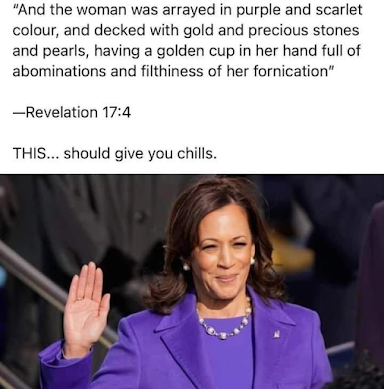
The Proper Context of Revelation 17:4

 I usually do a pretty good job avoiding politcal social media posts. Well, overall "pretty good" is the key. Usually my fingers just keep scrolling up, even when my brain starts typing out a theoretical response to what I see as oftentimes just plain silliness. 

And then there are the times like today, where I just can't avoid it. So, instead of replying on someone's post and getting in a long drawn-out Facebook debate that will have no real impact and not make any real difference, I have chosen to use my own blog as a space to set my thoughts in line.

Here is the image that has gotten to me today:


Not so much the image has gotten to me, as this is our US Vice-President being sworn into ofice on Jan 20, 2021 on 2 Bibles (obviously cropped out of this picture), but rather the irresponsible use of Scripture taken out of context and set to do harm against others is what has really gotten to me. 

While I avoid the political debates, I will gladly engage in a hermeneutical excursus of Scripture. This isn't about Democrat or Republican, this is about the reverence and authority of God's Word that should be rightly handled in such a way as to edify the people of God and lead us into holy living through sanctification (i.e. what Kenneth Collins calls "holy love").

So, let's look at this verse, shall we?

The King James Version translates this as "And the woman was arrayed in purple and scarlet colour, and decked with gold and precious stones and pearls, having a golden cup in her hand full of abominations and filthiness of her fornication:"

The New International Version says, "The woman was dressed in purple and scarlet, and was glittering with gold, precious stones and pearls. She held a golden cup in her hand, filled with abominable things and the filth of her adulteries."

Since this is a New Testament verse, it's a good idea for those responsible teachers of Scripture to at least see this as well:

καὶ ἡ γυνὴ ἦν περιβεβλημένη πορφυροῦν καὶ κόκκινον, καὶ κεχρυσωμένη χρυσίῳ καὶ λίθῳ τιμίῳ καὶ μαργαρίταις, ἔχουσα ποτήριον χρυσοῦν ἐν τῇ χειρὶ αὐτῆς γέμον βδελυγμάτων καὶ τὰ ἀκάθαρτα τῆς πορνείας αὐτῆς,

In Revelation chapter 17 one of the seven angels comes to show John the "punishment of the great prostitute" (17:1b)

Who is this prostitute mentioned here?

As the angel explains to John the meaning of this vision we see that the beast upon which this woman rides is the Roman empire, called Babylon the Great (see chapter 13). And this woman is sitting upon this beast.

And then this verse ends chapter 17, 

"The woman you saw is the great city that rules over the kings of the earth". 

"καὶ ἡ γυνὴ ἣν εἶδες ἔστιν ἡ πόλις ἡ μεγάλη ἡ ἔχουσα βασιλείαν ἐπὶ τῶν βασιλέων τῆς γῆς.”

πόλις = city

The word πόλις (pronounced polis) is the Greek word translated as a city where one lives or the inhabitants of a city (Strongs Concordance).

The woman (i.e. "prostitute") is NOT Kamala Harris. It is a metaphorical image of Rome. 

And for my Democratic friends who have posted that former President Donald Trump is the anti Christ, that is not biblically accurate either. I will be happy to post on that as well. 

Let's do better, and let's love one another as we anticipate the primary goal of the book of Revelation, and the culmination of our human existence:

Then I saw “a new heaven and a new earth,”for the first heaven and the first earth had passed away, and there was no longer any sea. 

I saw the Holy City, the new Jerusalem, coming down out of heaven from God, prepared as a bride beautifully dressed for her husband.  

And I heard a loud voice from the throne saying, “Look! God’s dwelling place is now among the people, and he will dwell with them. They will be his people, and God himself will be with them and be their God.  

He will wipe every tear from their eyes. There will be no more death or mourning or crying or pain, for the old order of things has passed away.”

He who was seated on the throne said, “I am making everything new!” Then he said, “Write this down, for these words are trustworthy and true.” (Revelation 21:1-5)

Amen. Come Lord Jesus. (Revelation 21:20b)