Tuesday, April 2, 2019

What I love about my job


            I love being a pastor.
            I love the feeling that I am actually doing what I am meant to do, that the personal gifts and graces that God has endowed to me are being put to the best use I can to live into who God has created me to be, and that, at least in some small way, I am making a difference.
I love preaching sermons. I think anyone who knows me knows this about me. And I hope that anyone who has heard me preach can see a glimpse of my passion for this part of ministry. Much of my week is gearing up to the proclamation of the sermon on Sunday morning, then Sunday afternoon I begin on the process for the next Sunday. The 2 churches that I have served have helped me grow so much in this, and I am grateful.
            I love reading and studying the Bible. I find hope and encouragement, challenges and reprimands in these pages of Scripture. I enjoy time in God’s Word. I guess this is why I love leading small groups, (aka "Bible Studies"), where we can talk about how to apply these Scriptures in our day to day lives, and how to really live them out. Or, what we simply don't understand.
            I love visiting people in their homes. I don’t get to do this near as much as I would like, even pastoring a smaller membership rural church. Life and work get busy. But I do love sitting around a table and talking about life, family, hopes and dreams. 
            I don’t really love church meetings, but to be honest I don’t mind them all that much, unless the meeting info could have been covered in an email, that frustrates me a little, but I kind of like getting together with other ministry leaders and prayerfully seeking God’s direction and then making plans and put those plans into action.

            As I am writing this column I have the on-call pager on my desk. 

           I serve once a month as an on-call overnight chaplain at the Johnson City Medical Center hospital. I will carry the pager for about 16 hours, and respond to situations that often are dealing with end of life. Tonight I have had the pager four hours, and have had two calls. I feel like it’s going to be a long night.
            But I love this.
            I love all those other areas of being a pastor, but I love being with people at these very difficult times in their lives and in the lives of their family and loved ones. I didn’t know that I loved this until I was at the hospital (a lot) as I completed a unit of Clinical Pastoral Education (CPE) as part of my United Methodist education. By completing a unit of CPE I could get credit that equaled 3 classes at Duke (6 hours) toward my ordination requirements. So, I was a student chaplain to get course credit.
            And somewhere in the process I loved it. Some of this was probably due in part to others I was with at the time, Jeff, Ed, Heather, and Cass, to name a few.
            Sam Wells wrote a book called A Nazareth Manifesto. In his book Wells states that the most important word in the Bible is “with”.  God is with us. We are with one another.

            In CPE we called this “the ministry of presence”, and that is, I believe, why I love this aspect of my work.
            In the hardest times in life I can be with someone. And God is with us as well. 
            And this reminds me of one of my favorite passages of Scripture. It’s in 2 Kings 6. The King of Aram has tracked down Elisha and his servant and has them surrounded and is planning to kill them. In the soft light of the early morning dawn Elisha’s servant looks outside the tent and freaks out; they are surrounded! Granted, the situation is bleak.
            But here’s what I love about this story (2 Kings 6:17):
“And Elisha prayed, ‘Open his eyes, Lord, so that he may see.’
Then the Lord opened eyes,
and he looked and saw the hills full of horses
and chariots of fire all around Elisha.”
            I believe that in these holy moments we are not just surrounded by what is trying to hurt us, but we are also surrounded with the angelic forces of God's protection and provision. Sometimes we can’t see them because we are too wrapped up in the situation, or prognosis, at hand. But the reality is that they are there. 
            With us.
            I am thankful for times to be with people to remind them that “those who are with us are more than those who are with them” (2 Kings 6:16b).
           I love sharing this truth with people.
           I love being able to share this with my family, reagardless of what we are going through. I love them so much, and we are with one another, and we have an army with us. And so do you. 
           I love being a United Methodist, united in Christ and united with one another.

            Maybe you’re not in a hospital room at this moment in a very near time of moving from this world to the next, but I want to remind you today that you are not alone, and offer a prayer for you that God’s angels uphold and protect you, and that your eyes be opened today to the beauty and hope of God’s plan for you in Christ Jesus, who is with you. Amen.

Tuesday, February 12, 2019

Jesus needs your boat


I have been preaching through the gospel of Luke this year, and recently I came back to the passage in Luke 5 called the ‘miraculous catch of fish’ (Luke 5:1-11). The premise is that Jesus had been preaching and teaching to the people, and that the crowd had gotten so big that Jesus got in Peter’s boat and preached to the crowd from there.
“He (Jesus) got into one of the boats, the one belonging to Simon (Peter), and asked him to put out a little from the shore” (Luke 5:3).
Peter was a fisherman, Peter had a boat. Jesus asked Peter to use his boat, because that’s what Peter had to offer. Sometimes we skip over such great details in the Bible because we want to get right to the miracle. Maybe we do the same things in our life as well? But every detail in Scripture is here for a reason. The miracle will happen, and we will get there. But first notice that Jesus used what Peter had.
You are uniquely equipped for special purposes that God has in store for you, God has given you what God needs to use you to fulfil his Kingdom purpose.
Jesus is gonna ask to use your stuff, because He has given it to you for a reason, and maybe that reason is for such a time as this.
And what about that crowd? It would have been easier for Jesus to send them away, or to tell them they needed to get in small groups (or Sunday School classes or Life Groups, or whatever we call them now) because that would be easier to manage. Or maybe they should just go to the synagogue on the Sabbath to hear the word of God.
But Jesus didn’t do that. On June 6, 1742 John Wesley, the founder of the Methodist movement, came back to Epworth, England his hometown. The priest there did not want John to preach that day, because John had become, what the church, called, “an enthusiast”. This group of people were advocating for a revival of the Holy Spirit in worship, and seemed OK with going out to preach on the docks and in the fields, and even take the sacred wine and bread of the Eucharist to people where they were, instead of requiring people to come to church.
A group of people wanted to hear what Wesley had to say, however, so since he was not allowed to preach in the church, he told them to come back at 6PM and he would preach outside the church. John’s father had been the pastor of this church for many years, and there was a cemetery behind the church. At 6PM the crowd was so large that John could not see them all. He was in a cemetery so there wasn’t anything to stand on so that he could see all the people in the back except…his father’s tombstone. So, John stood on that tombstone, and wrote in his journal that “I stood near the east end of the church, upon my father’s tomb stone and cried, ‘The kingdom of heaven is not meat and drink, but righteousness, and peace, and joy in the Holy Ghost.”
Our Christian DNA is to preach the word of God creatively in any circumstance so that all the people can hear. John’s pulpit was his father’s grave, and Jesus’ pulpit was a boat on the Sea of Galilee.
Sometimes we have to move to be able to really see the people.
                Maybe that means getting out of what is comfortable to us. The church where I serve as pastor has a motto of “Open Hearts. Open Minds. Open Doors”. I wish that were really true for all of us, that we would go to whatever imaginable height, or depth, to share with just one person the love that Jesus has for them. That’s what Jesus meant when he said a shepherd leaves the 99 sheep to go after the 1. It doesn’t make sense, really, unless you are the 1.
                How can we move to be able to see the people around us and share God’s Word to them where they are?               

Tuesday, February 5, 2019

Sawabona


I read a blog from Junius Dotson, the United Methodist Secretary for Discipleship Ministries, and he wrote:
“In Johannesburg, South Africa, I learned a greeting called “Sawabona.” It translates to something like “I see you,” or “We see you.” The traditional response is “Yebo, sawabona,” which means “Yes, I see you, too.”
Something I found very interesting – and very heartwarming – about this greeting is that it says, in effect, that I acknowledge your presence. I recognize the dignity of your existence. You are not overlooked. You are not ignored.”[i]
That reminded me of a story from the Bible. In Genesis chapter 16, we are told that a servant-girl named Hagaar had ran away from her master Abraham and  his wife Sarah. Hagaar had given Abraham a son, but Sarah, Abraham’s wife, became very bitter and mean toward Hagaar (even though it was Sarah’s idea to have her husband have sex with Hagaar). While Hagaar was pregnant, she couldn’t take it anymore, and ran off alone into the desert.
 Let me just say here that was messed up! I hear people say how awful our society is today, and how far we have fallen morally, and while I agree there is a great gulf between the “world” and the things of God, there has been since Genesis chapter 3. Some of the stories in the Old Testament are atrocious as to why people did what they did, much like today. I don’t necessarily think that things are all that much worse, but they are differently bad.
So, back to the story. Hagaar sat down beside a spring in the wilderness. She was alone. She was tired. She was helpless. She had no hope. Then an angel from God showed up and gave her encouragement, and proclaimed a future for her and for her son.
The part I find most interesting is Genesis 16:13,
“Hagaar used another name to refer to the Lord, who had spoken to her. She said, ‘You are
the God who sees me’.”

In the United Methodist church where I serve as pastor we have begun a 2019 worship series from Discipleship Ministries entitled, “See all the People”. The basis of this series comes from the children’s rhyme, “this is the church, this is the steeple, open the doors and see all the people”.  Fittingly, our UMC slogan is “Open hearts. Open doors. Open minds”.

Yesterday I got to play peek-a-boo with a friend’s grandson. His name is Josiah. Josiah loves to be held by one person, while another person is hiding behind their back, says his name, “Josiah, Josiah”, and then pops up in front of him with a “peek-a-boo, I see you”.  It made him laugh, so that was fun. But it reminded me of this basic instinct that we all have from a very young age to be known by name, and to really be seen.

There are people who desperately need to know that they are seen.  There are people in our church buildings who come in every Sunday and sit on the pews, but need to know they are seen. There are cashiers who scan your groceries, servers who bring your food to your table, even strangers standing in line at the bank, who need to know that they are seen.
There are homeless and hurting people who feel invisible to the society around them, a society that they don’t even feel that they are a part of. There are hurting and broken people who feel ashamed to show others who they really are, for fear that being really seen would mean to be rejected. There are wives in abusive relationships who just want to be seen.
There are young children, both boys and girls, suffering the atrocities of human slavery.
And God sees them.
And we are called to see them to too!
#Allthepeople
Hagaar named the place where the angel came to her Beer-lahai-roi, which means “the well of the living One who sees me”.
El-roi means the God who sees you.
In whatever place you find yourself today, there is hope. You are not alone.
Sawabona, my friend. I see you. And God sees you.


[i] https://us1.campaign-archive.com/?u=756434a4416d9bc710b1f7cfe&id=d06f57ee38&e=373f106bc4

Friday, January 25, 2019

The Temptation of Anger

So I found this book, "Great Sermons by Great Preachers" (1927) on my bookshelf.

I don't remember exactly where I got it, or how long I've had it. But I decided that I would read one of these sermons a week. There are sermons from Luther, Spurgeon, Bunyan, Edwards, Chrysostom, and of course, Wesley, as well as a whole slew of preachers from the beginning of Christondom up to the turn of the 20th century.
Today's sermon was from Aurelius Augustine, aka St. Augustine, written sometime around 420 AD, entitled "On the Lord's Prayer". This is significant for me, because as a church we are committed to praying this prayer every day for 40 days as we began 2019.


                                                                 #40DaysofOurFather

Augustine takes the approach to divide up the phrases of the prayer and expound generally and briefly upon each one.  "Our Father who art in heaven", "Hallowed be thy name", etc.

What struck me today was his comments on "lead us not into temptation". Augustine here focused inward rather than outward. And on one particular temptation, rather than the many "outward" temptations that beset us regularly, daily, or hourly.

The inward temptation that, for Augustine, this passage clings on, is anger (vengence). The preceeding words of the prayer, "Forgive us our debts (trespasses) as we forgive our debtors (those who trespass against us)" is key for Augustine to the next step in the prayer, "AND Lead us not into temptation".

"What then is that firghtful temptation which I have mentioned, that grievous, that tremendous temptation, which must be avoided with all our strength, with all our resolution; what is it? It is when we go to avenge ourselves. Anger is kindled, and the man burns to be avenged."

I usually do not go straight to thinking about my anger with others, or my desire to be avenged when I think about this part of the prayer. But this temptation does place me at the center focus, I am the locus point and my desire against someone else (perhaps because of what was done to me or said to me, or maybe even what was not done) becomes the primary focus.
Yet we have just asked the Lord to forgive us...as we have forgive others anything (debt, sin, or trespass) that they have done (or not done, or said, or not said) against us.

So I was wondering today, where this temptation sits with me? And as a reader, where does it sit with you? Is there anger in your heart today toward another person?

This prayer that we call "The Lord's Prayer" is found in Matthew 6, as part of a series of sayings of Jesus recorded by Matthew as part of the sermon on the Mount.
The prayer is Matthew 6:9-13. But the very next 2 verses say:
"For if you forigive other people when they sin against you, your heavenly Father will also forgive you. But if you do not forgive others their sins, your Father will not forgive your sins." (Matthew 6:14-15)
It seems that for those people in those hard times in our lives that sometimes we simply can't move on past the feelings. Maybe we feel that we are justified in how we feel, after all, we didn't do anything wrong, which means that all the wrong is on the other person.

But, at least thinking about this prayer today, I don't think it's a matter of right/wrong, or even who is to blame and who is not. After all every one of us has sinned (Romans 3:23).

We are praying this prayer between us and our God. Our righteous, holy ("hallowed be thy name"), perfect, and loving ("Our Father") Judge. And since we are none of these things and God is all of things, we leave it in His capable hands (Romans 12:19).

Augustine offers this hope, "If ye shall see any anger making a stand against you, pray to God against it, that God may make thee conqueror of thyself, that God may make thee conqeror, I say, not of thine enemy without, but of thine own soul within. For He will give thee His present help, and will do it."
If there is anger/vengence in your heart toward another as you pray this prayer today, then I pray with you that God will make it known and that God will be your very help right now to conquer through grace and forgiveness. We have been forgiven much, so as forgiven and redeemed people, let us be the first to offer much forgiveness. This will lighten your soul. The anger that you are holding to is poison to you, not the person to whom you harbor these feelings. By the grace of God, and in the name of Jesus, today, let it go.


Great Sermons by Great Preachers, Jessse Hurlbut, ed, (The John Winston Company, Chicago, 1927), 31-39


Tuesday, January 22, 2019

God of the Old & God of the New


I have spent a lot of time in the Old Testament book of Kings this month. And I mean “A LOT” of time. I just completed an intensive course in Old Testament exegesis of Kings this month at Duke Divinity School. And as a result, I am thinking a lot about some of those stories and some of those people.
There are great stories in the books of Kings, stories that when we properly understand them, helps us understand the New Testament better. In fact, I am going to go as far as to say that you cannot understand the New Testament if you don’t understand the Old Testament. I know that might seem like a bold statement, but if you don’t understand the need for the Messiah, if you don’t see the correlation between the fall of humanity in the garden of Eden and the redemption of humanity through the cross at Golgotha, if you don’t see how having a “Davidic King” sit on the throne forever is part of an everlasting covenant, then I don’t think that you can effectively understand the New Testament when you read about Jesus.
            Remember, Jesus said, “Do not think that I have come to abolish the Law or the Prophets; I have not come to abolish them but to fulfill them” (Matthew 5:17).
            When you read the Old Testament through the lens of the Gospel, you see what Jesus was talking about. Jesus is not just introduced in the Gospels as a baby born in Bethlehem. That was just His incarnation into humanity. Jesus is God, pre-existent with the Father and the Holy Spirit. The apostle John, in his gospel, said it this way; “In the beginning was the Word, and the Word was with God, and the Word was God. He was in the beginning with God. All things were made through Him, and without Him was not anything made that was made” (John 1:1-3). The “Word” mentioned here is Jesus. Think pre-creation, and Jesus was there.
            All of the Bible is God’s Words.
            Some people mistakenly think that the God of the Old Testament is somehow different than the God of the New Testament. Jesus, they think, just seems nicer when talking about love and forgiveness than the God who instructed Moses to kill nations in conquest or who made prohibitions and rules against so much. That line of thinking dates back to at least the second century, and is found in a heretical theology of the early church called Gnosticism.
            I say all of this, simply to say that all of your Bible is important. It is all there, given as a gift, and for a reason. And the reason is not just to teach, thought the Bible surely teaches us in many ways. And the reason is not just to instruct, though the Bible surely offers invaluable instruction. And the reason is not just to provide a narrative history, though the Bible surely offers historical data.
The Bible is here to connect us with God. This is a beautiful, and very complex, story of God’s greatness, of God’s power, and most of all, of God’s love. And God’s love has been ever present, unchangeable, and never-ending. And His love is for you. From the beginning of creation in Genesis, through the ups and downs of life and exile through Kings and Chronicles, through the incarnation at Bethlehem in Luke and into the eternal promise fulfilled in Revelation, the Bible is a story of God with us. Emmanuel.
Take some time this year to read through some of these great stories of God’s love for you. Find a Bible reading plan that is a good fit for you. Engage with a small group Bible study in your church. Or just read through 1 and 2 Kings. God’s love and God’s presence will meet you there.  

Tuesday, November 27, 2018

King Jesus


It’s beginning to look a lot like Christmas. Trees and homes and churches are decorated with lights and wreaths and greenery. The nativity and the Elf on the shelf have made their way from the closets to prominent places within the home. There are cards to be addressed and presents to be purchased and parties to attend and, of course, holiday goodies to eat.
            But it’s actually not Christmastime, it’s Advent. The word “Advent” means arrival, and this month we focus on the Advent, or arrival, of the long awaited Messiah, Jesus. It is a time where we remember the birth of Jesus in Bethlehem, as well as look forward to the day that he comes again. His second Advent.
            And during this season the most often thought of image of Jesus is as a cute little baby boy wrapped in snuggly blankets lying in a pristine manger filled with clean and comfortable hay. While this is not exactly how I picture this first night of Jesus’ birth (and I really don’t think it was a “silent” night either), the image of Emmanuel, God with us, in the form of a baby boy is a beautiful image of God’s love and His perfect plan of redemption for all of His creation.
Image result for baby jesus
            
            Of course there are other images that come to mind when we hear the name of Jesus.
Jesus the shepherd invokes the image of Christ carrying the lamb on His back as he walks back to the fold to reunite the lamb with the other 99 (Luke 15:3-7).
Image result for jesus with lamb painting
Nathan Greene
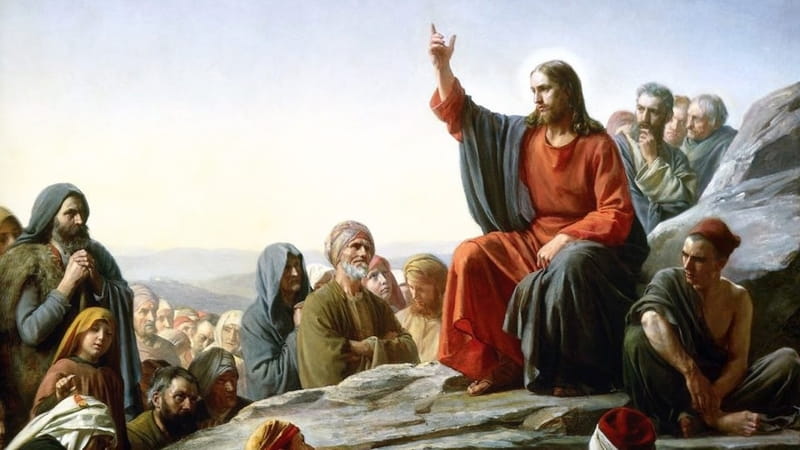
            And there is the image of Jesus as teacher, where I imagine Him on a rock while thousands of eager listeners are fed through the words of this perfect rabbi (Matthew 5-7).
            

                I see Jesus the miracle worker as He spits in the mud and wipes the mixture in the eyes of a blind man and tells him to go wash in a pool and then he received his sight (John 9:1-7).
Image result for jesus spit in dirt
            

               And one of my favorites is the image of Jesus as the loving father, hiking up His robe to run down the road to embrace His long lost prodigal son who had just returned home (Luke 15:11-32).
Image result for prodigal son father running
           

            The image of Jesus on the cross taking on the sins of the world, all of mine and all yours, the perfect lamb of God, is an image that I think of daily as I confess my sins and ask for his forgiveness new and fresh each morning.
Image result for jesus on the cross
            

           All of these images, and many others, reflect perfect pictures of who God is. They all show an aspect of God’s perfect and multi-faceted character.
            But this is Advent. And while the picture of Jesus in the manger may get the most air time this month, we cannot forget that is season of waiting and anticipation is as much about looking forward in hope as it is looking back in remembrance.
            And so today I want to leave you with this Advent image of Jesus that John gives us in the introduction to Revelation.

“Look, he is coming with the clouds, and every eye will see him, even those who pierced him; and all peoples on earth will mourn because of him. So shall it be! Amen. “I am the Alpha and the Omega,” says the Lord God, “who is, and who was, and who is to come, the Almighty.” (Revelation 1:7-8)
                                            
                                           King Jesus. That’s the image on my mind today. 
Image result for he comes riding on a cloud
          
           As we come into this Advent season, is Jesus the King of your life? Every area of your life? We do, after all, have an incredible ability to compartmentalize life. Is King Jesus King over all, or is He just a governor over certain territories you have allowed Him?
            This Advent, I pray that God’s kingdom come in a powerful and beautiful way in your life. I pray that you have accepted Christ’s Kingship and that you are living with a Kingdom-focus in every area of your life. And I pray this abundant life in Jesus (John 10:10) will be your offering of praise to the King of Kings this month, and forever more.


Tuesday, November 13, 2018

Confident in Christ


Many years ago, when I played high school baseball, I had a walk-up song. If you’re not familiar with a walk-up song, it is a song that is played as a batter walks from the on deck circle to home plate. My walk-up song was by a new rock n roll band, Guns N Roses, and the song was Welcome to the Jungle. I probably even strutted a little when I walked up.
            Now, let me explain something. I didn’t have this loud and in your face rock song playing because I knew that I was that good, I played it because I feared I wasn’t.
            I was about a .200 hitter in a good year. If you don’t follow baseball that means that I got a hit about once every 5 times up to bat, or so. And that’s not very good. So to try to get in the pitchers head I had a song played that I hoped made me look more confident than I was. But in reality I probably just looked cocky.
            Cocky is when you act like something you’re not. Confident is when you believe something to be true or have faith that something will or will not happen. I wasn’t confident in my batting, so I tried to fake it.
            What I did as a teenager on the baseball field, many people do in other areas of their lives. And it’s because they are not confident in who they are. The Bible has a lot to say about who we are and the confidence that we can have because of this.
            In 1 John, the writer says this:
“And we are confident that he hears us whenever we ask for anything that pleases him. And since we know that he hears us when we pray, we also can be confident that he will give us what we ask for” (1 John 5:14-15)

            I know too many people that aren’t confident. They aren’t confident in their abilities, their looks, their relationships, their faith. And then because of this they try to do things or act in ways so that other people will think differently of them. But the truth is that’s just fake.
            We can be confident that God hears us when we pray.
            While I wasn’t confident as a batter in baseball, I was confident when I played defense. I was a catcher. So at any moment that I was on the field behind the plate I was thinking about the pitcher, how he felt and what he was thinking, how his mechanics looked. I thought about the batter, my other teammates on the field and where they were positioned, and even the umpire with his hand on my back. I thought about all these other people.
            Maybe that is a truth in confidence. When we focus on others we can be confident in what we do, but when we focus on ourselves we just get cocky.
            Hebrews 4:12 says that we can come with confidence before the throne of God. This is because of what Jesus has done for us. The source of our confidence isn’t really within us, it’s within God in us. We find our confidence not in ourselves, but in Him. That’s why Philippians 4:13 says that “I can do all things through Christ who gives me strength”.
            You can be confident that when you pray the God of the universe hears you! Let that sink in for just a minute, please!
            You have been given confidence through Jesus. Live in this, believe in this, have faith in this, and be confident in this.